
PRAISE: A Study Method
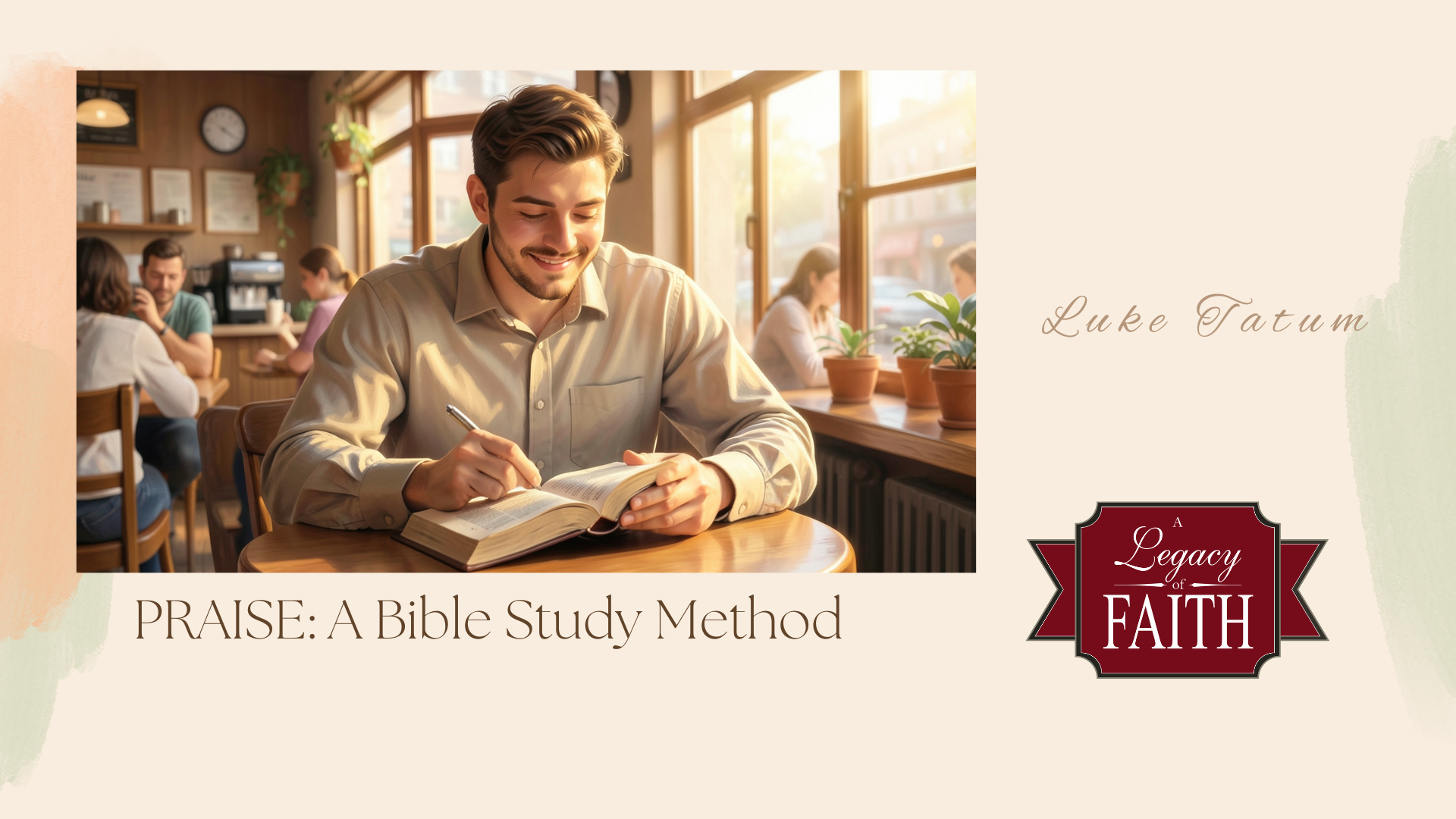
This is less an article and more an idea I’ve been working on for a while now. I am sharing partially because I am in search of feedback, positive or constructive. If you love this idea, I’d love to know it; if you hate this idea, I’d love to know it. Anyway, on with the show.
I have been exposed to many different study formats over the years, which has led me to take the best parts of the ones I like and incorporate them into my regular practice. There are three principles which, in my opinion, are essential to a faithful and productive Bible study: an examination of both text and context, a methodology based on asking questions and seeking answers to those questions, and a stated emphasis on application. In my perusing of other study methods, I have often found studies that do one or two of these very well, but rarely if ever have I seen anything that explicitly gives weight to all three. For a while now, I have been working on articulating a methodology that incorporates all three of these elements while being accessible regardless of the user’s familiarity with the Bible. This, therefore, is my attempt to give structure to my system, and to place significance on all three of these aspects in doing so. If you already have a method of study that you love, by all means keep to it. This is just one more idea, so take it or leave it as it suits you.
The steps of this method follow the acronym PRAISE, a choice which has meaning beyond just being a “church word.” The New Testament repeatedly challenges Christians to do all things to God’s glory (Matthew 5:16, 1 Corinthians 10:31, etc). It is often the case that I fail to do this in my Bible study because I treat study as a passive activity, or at best an activity that stops once I’ve closed the book or the app. The goal of this method is, in part, to encourage its users to extend our understanding of Bible study to include the actual practicing of application on the basis of what we have explored in the text, while also making the exploration itself more intentional. In this way, more than any other, we can fulfill the call of the New Testament to glorify God in and through our study of the Word.
Without further ado, here are the steps of the PRAISE method and their meanings:
1. Pray for Understanding - Never study the Bible without talking to the Author! I am not smarter than God and did not write the Bible like He did, which means that I will never see as much in His inspired Scriptures on my own as I can with His help.
2. Read the Text - This involves two elements: reading the text as attentively as possible, and reading the text with as little personal bias as possible. This is hard to do, especially with as many preconceived notions about the Bible as many of us have, but the attempt is essential if we are to learn what God wants us to learn from the text.
3. Ask Questions - Make a list of known and unknown quantities from the text, and express the latter in the form of questions. I often tell my youth group kids that “there is such a thing as a bad question, but there is no such thing as a bad Bible question.” Asking questions about the text is proof that I have paid attention to it well enough to have them! It also helps me to set goals for my further investigation. These questions can be anything - meanings of words, identities of characters, how I should apply a statement or passage to myself - but I usually try to stick as closely to the text as possible in generating questions. (“But what if I ask the wrong questions?” This would be part of why this method starts with prayer; ask God for wisdom in asking the right questions of His Word, and my guess is He will grant it.)
4. Investigate the Text and Context - Using the list you have already made, search the text for further understanding. This first involves a close reading and examination of the text itself, followed by a thorough study of the various layers of context that a passage carries. Sources differ on how best to handle layers of context; for my part, I usually work from the inside out, starting with the immediate context (paragraphs just before and just after the key text), then greater context (the book as a whole), then historical-cultural context (the who, what, when, where, and why surrounding the book and its author/audience). I would submit that either this or its exact opposite, working from the outer context and towards the center of your key text, is probably best. As you go, let the text and its context answer the questions you have stated before, working from known quantities towards unknown quantities. You may not find every answer (and that’s OK), but you’ll find the ones God wants you to find and that you most need to find. It is likely that the second time you study the same passage in this way, you will ask and answer more questions than you did the first; the same will be true with the third time compared to the second, and so on.
5. Set Expectations - Once you have sought answers and conclusions from the text and your associated questions, use them to make points of practical application. This is the point at which the “whos,” “whats,” and “whys” of the study become “hows.” How should the principles of the Word and the answers it provides to my questions affect my relationship with God, others, and myself? Be sure to account for the difference in application between the original audiences and modern audiences. (For example, I am not usually tempted to cause my brother to stumble by eating meat offered to a pagan god, but I am tempted to cause my brother to stumble by insisting on other practices carelessly and without considering his good.)
6. Exercise Belief - Bible study does nothing if it doesn’t change you once the Bible is closed! Before you get up from the table or close the app, come up with a specific plan to apply your conclusions and points of application, meeting the expectations that the text has set. Then stick to it! (This will likely require prayer as well, and so the cycle begins to repeat itself.)
Again, this is just one of many suggested study methods, and if you have one that works well for you, stick with it. If not, here is something to try sometime. Let me know how it goes and any feedback you have for it. Either way, let this be your sign to study the Bible today! The journey to becoming a student of the Word starts with the first conversation with the Teacher.
AUTHOR: Luke Tatum